A Practical Procurement Guide to Evaluating Freight, Customs Tariffs, Inspection, Packaging, and Total Landed Cost per Unit
When sourcing personal care products from China, many buyers focus on one single number: the factory unit price.
A supplier offers an electric toothbrush for $5.50, while another quotes $6.20. At first glance, the first supplier appears to be the more cost-effective choice.
But is it really?
The factory quotation is only one part of your total purchasing cost. International freight, customs duties, import VAT/GST, pre-shipment inspection, packaging customizations, currency exchange fees, and destination warehousing can significantly increase the final cost of goods received.
For importers, distributors, retailers, and private-label brands, understanding the total landed cost of products from China is essential before approving a purchase order.
In this guide, RYVO explains how to calculate the total landed cost of personal care appliances, what hidden expenses buyers frequently overlook, and how to avoid costly surprises when importing from China.
1. What Is Landed Cost in Product Sourcing?
Landed cost is the total comprehensive expense of manufacturing a product, clearing it through export/import customs, and transporting it from the Chinese factory floor to its final destination warehouse.
It represents the true baseline cost of inventory upon arrival.
The Total Landed Cost Formula:
Total Landed Cost = Product Purchase Cost + Domestic Origin Logistics + International Freight + Marine Insurance + Import Customs Duties + Port & Terminal Handling + Third-Party Inspection + Final Mile Inland Delivery + Transaction/Banking Fees
Landed Cost Per Unit = Total Landed Cost ÷ Total Order Quantity
Understanding this metric allows procurement managers to compare suppliers based on the actual landed expense rather than relying on misleading factory-gate quotations.
2. The 7 Main Cost Components Buyers Must Calculate
The base price quoted by the manufacturer. Dictated by motor architecture (brushed vs. BLDC), battery chemistry, PCBA chips, housing resin, and accessories.
Factory-to-port trucking in China, warehouse consolidation (for multi-factory procurement in Yiwu/Ningbo/Shenzhen), and export terminal documentation.
Ocean container freight (FCL/LCL), air cargo, or express courier. Strongly influenced by master carton CBM volume and chargeable weight.
Calculated based on destination country HS Code classification (e.g. 8509.80 for toothbrushes/flossers, 8516.31 for hair dryers, 8510.10 for shavers).
Customs broker filing fees, port entry handling, ISF 10+2 bond (for US ocean freight), and security clearance charges.
Pre-shipment inspection (PSI) under AQL 1.0/2.5 standards to verify assembly, functional performance, and packaging before releasing the final balance.
Local drayage trucking from destination port/airport to your warehouse or Amazon FBA fulfillment center, including liftgate and palletization fees.
3. EXW, FOB, CIF and DDP: Why Your Quotation Terms Matter
One of the most frequent mistakes is comparing quotations governed by different Incoterms. These prices cannot be directly stacked against each other:
| Incoterm | What Is Included in Supplier Price | What Buyers Must Pay Separately |
|---|---|---|
| EXW | Product available at factory gate only. | China domestic trucking, export customs clearance, terminal handling, ocean freight, tariffs, and inland delivery. |
| FOB | Delivered onto vessel at named China port (e.g. Ningbo/Shenzhen) + export clearance. | International ocean/air freight, cargo insurance, import tariffs, destination port handling, and inland trucking. (Recommended B2B Standard). |
| CIF | Product + export clearance + ocean freight + marine insurance to destination port. | Destination port terminal charges (THC), customs entry filing, import tariffs, and local warehouse delivery. |
| DDP | All-inclusive: Product, freight, customs clearance, import tariffs, and delivery to warehouse. | Zero additional logistics payments. Turnkey landed pricing. |
Need an Accurate Landed Cost Model for Your Product?
RYVO helps international brand owners calculate exact landed cost per unit, optimize carton CBM loading for 20GP/40HQ containers, and verify HS Code tariff classifications.
Request a Sourcing Cost Review →4. Landed Cost Calculation: A Practical Case Study
Let's examine a real-world purchasing scenario for an order of 500 units of an OEM Sonic Electric Toothbrush sourced from Ningbo, China to a destination warehouse in Los Angeles, USA.
| Cost Breakdown Item | Calculation Basis | Total Amount (USD) | Cost / Unit | % of Total |
|---|---|---|---|---|
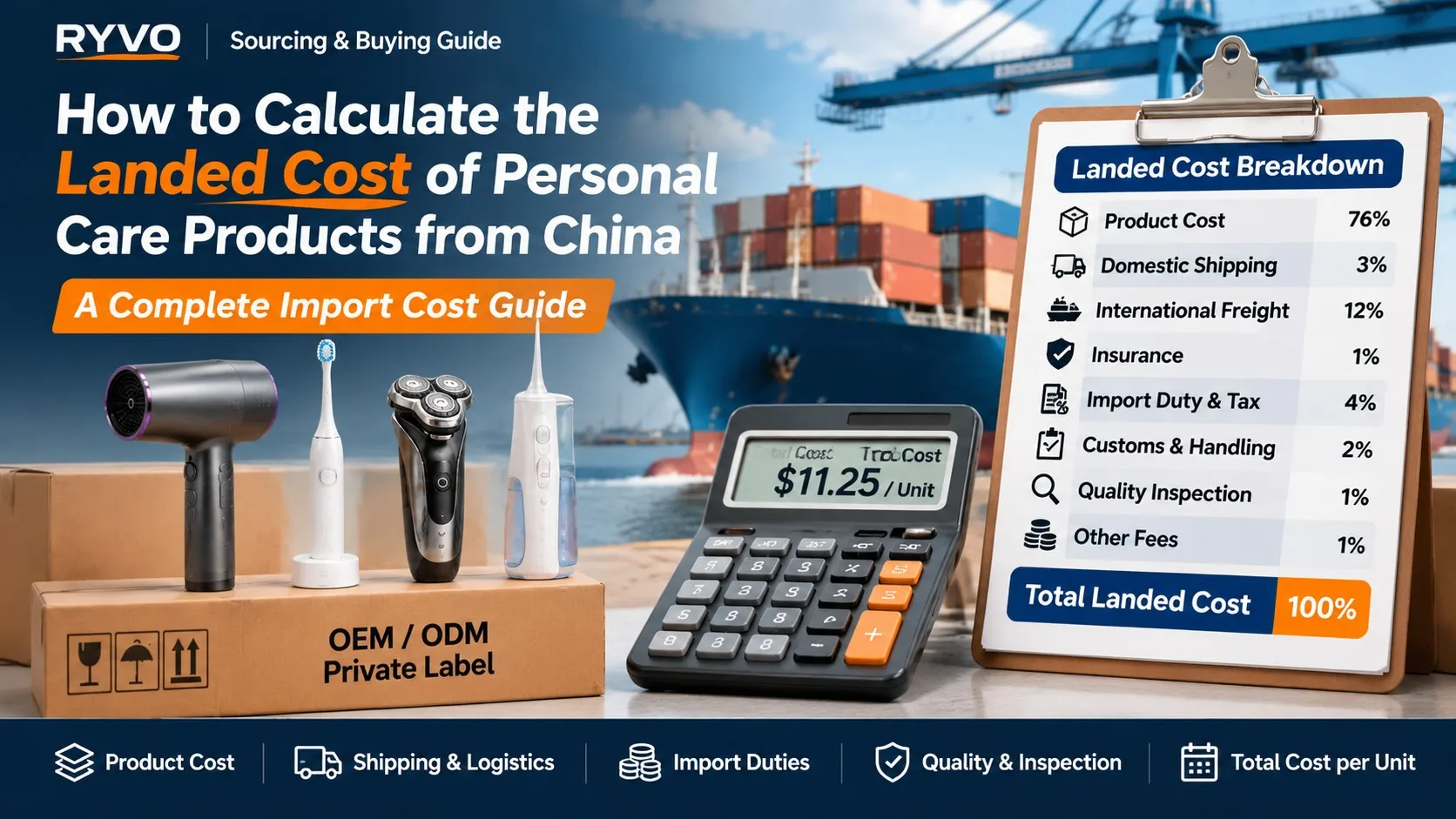
| 1. Factory Purchase Cost (FOB) | 500 units × $8.50 / pc | $4,250.00 | $8.50 | 75.6% |
| 2. International Ocean Freight (LCL) | 10 master cartons (1.2 CBM / 150 kg) | $650.00 | $1.30 | 11.6% |
| 3. Marine Cargo Insurance | 0.4% of CIF value + 10% | $40.00 | $0.08 | 0.7% |
| 4. US Import Customs Duty | Illustrative 4.0% on FOB value ($4,250 × 4%) | $197.60 | $0.40 | 3.5% |
| 5. Customs Clearance & Brokerage | Broker entry fee + ISF filing + harbor maintenance | $120.00 | $0.24 | 2.1% |
| 6. Pre-Shipment Quality Inspection (PSI) | AQL 1.0/2.5 on-site factory audit fee | $150.00 | $0.30 | 2.7% |
| 7. Local Inbound Trucking (Drayage) | Port of LA terminal to local warehouse | $180.00 | $0.36 | 3.2% |
| 8. Wire Transfer & Currency Fees | T/T telegraphic bank transfer & intermediary fee | $35.00 | $0.07 | 0.6% |
| TOTAL LANDED COST | Complete delivered order value | $5,622.60 | $11.25 | 100.0% |
*Note: The figures above are illustrative. Actual landed costs vary depending on exact HS codes, shipping season surcharges, port congestion, and destination country tax laws.*
Key Strategic Takeaway:
While the initial factory quotation was $8.50 per unit, the true landed cost received at the warehouse is $11.25 per unit — an increase of +32.4% over the factory invoice.
If the buyer priced their retail strategy based purely on the $8.50 factory quotation, their operating profit margins would be severely compromised.
5. Why Small Order Batches Suffer Higher Landed Unit Costs
Fixed logistics expenses (customs filing $120, inspection $150, bank wire $35, local drayage minimum $180) total approximately $485.00 regardless of whether you ship 100 units or 1,000 units.
- Batch Size 100 units: Fixed overhead adds +$4.85 / unit.
- Batch Size 500 units: Fixed overhead adds +$0.97 / unit.
- Batch Size 2,000 units: Fixed overhead adds +$0.24 / unit.
Procurement Strategy: For initial market validation, a higher landed cost on a 200–300 unit pilot batch is preferable to risking capital on an untested 3,000-unit production run. Once market velocity is verified, scale to Full Container Load (FCL) to achieve maximum freight efficiency.
6. Five Costly Landed Cost Traps When Importing from China
- Ignoring Chargeable Volumetric Weight: Lightweight but bulky products (e.g. hair dryers with gift boxes) are charged by dimensional volume (CBM × 167 kg/CBM for air cargo), resulting in freight bills 2× higher than expected.
- Incorrect HS Code Classification: Misclassifying a smart visual toothbrush or ultrasonic cleaner can lead to customs audits, retroactive tariff penalties, or delayed clearance.
- Overlooking Destination Demurrage & Pier Storage: Failing to submit customs paperwork (e.g. ISF 10+2, FDA Prior Notice) prior to arrival leads to expensive daily port storage fees.
- Excluding Quality Pre-Shipment Inspection: Skipping a $150–$250 factory inspection risks receiving defective batches where return shipping back to China is economically impossible.
- Unbudgeted Custom Packaging & Mold Fees: Discovering that custom retail blister trays or color boxes carry unstated plate fees ($50–$150/color).
7. How RYVO Helps Buyers Optimize Total Sourcing Economics
At RYVO, our engineering and procurement coordination extends beyond factory matching. We manage the entire lifecycle from BOM optimization to containerized export:
- Carton CBM & Pallet Optimization: We engineer master carton dimensions to maximize 40' HQ container fill rates (up to 95%+ cube utilization).
- Transparent BOM & FOB Quotations: We negotiate standardized FOB Ningbo/Shenzhen pricing with verified manufacturing partners.
- Pre-Shipment Quality Assurance (AQL 1.0/2.5): On-site pre-shipment inspections ensure every batch conforms to approved golden samples before final payment release.
- Regulatory & Battery Export Compliance: We verify UN38.3, MSDS, CE, FCC, and UL test reports to ensure seamless customs clearance.
Planning to Source Personal Care Products from China?
Contact RYVO to evaluate product specifications, compare supplier configurations, and calculate total landed cost models before committing your capital.
Request a Sourcing Cost Consultation →Direct Project Inquiry: bai@ryvocare.com | Based in Yiwu, Zhejiang, China
Frequently Asked Questions
Follow RYVO for actionable insights into China sourcing, landed cost modeling, BOM component teardowns, and supplier verification.