How long does it take to turn a product idea into a finished product ready for retail?
For many custom consumer products, the process may take around 3–6 months. More complex electronic products can require 6–12 months or longer, particularly when new tooling, multiple design revisions, extensive testing, or certification requirements are involved.
Key Planning Reality: These are planning estimates, not guaranteed lead times. An existing product platform with private-label customization can reach the market much faster than a product developed entirely from scratch.
For brands, Amazon sellers, distributors, and product managers sourcing from China, understanding the product development timeline is essential for planning launch dates, controlling development costs, and reducing procurement risks.
Let's use a hair clipper as a concrete example to explain the key stages of product development, from the initial concept to stable mass production.
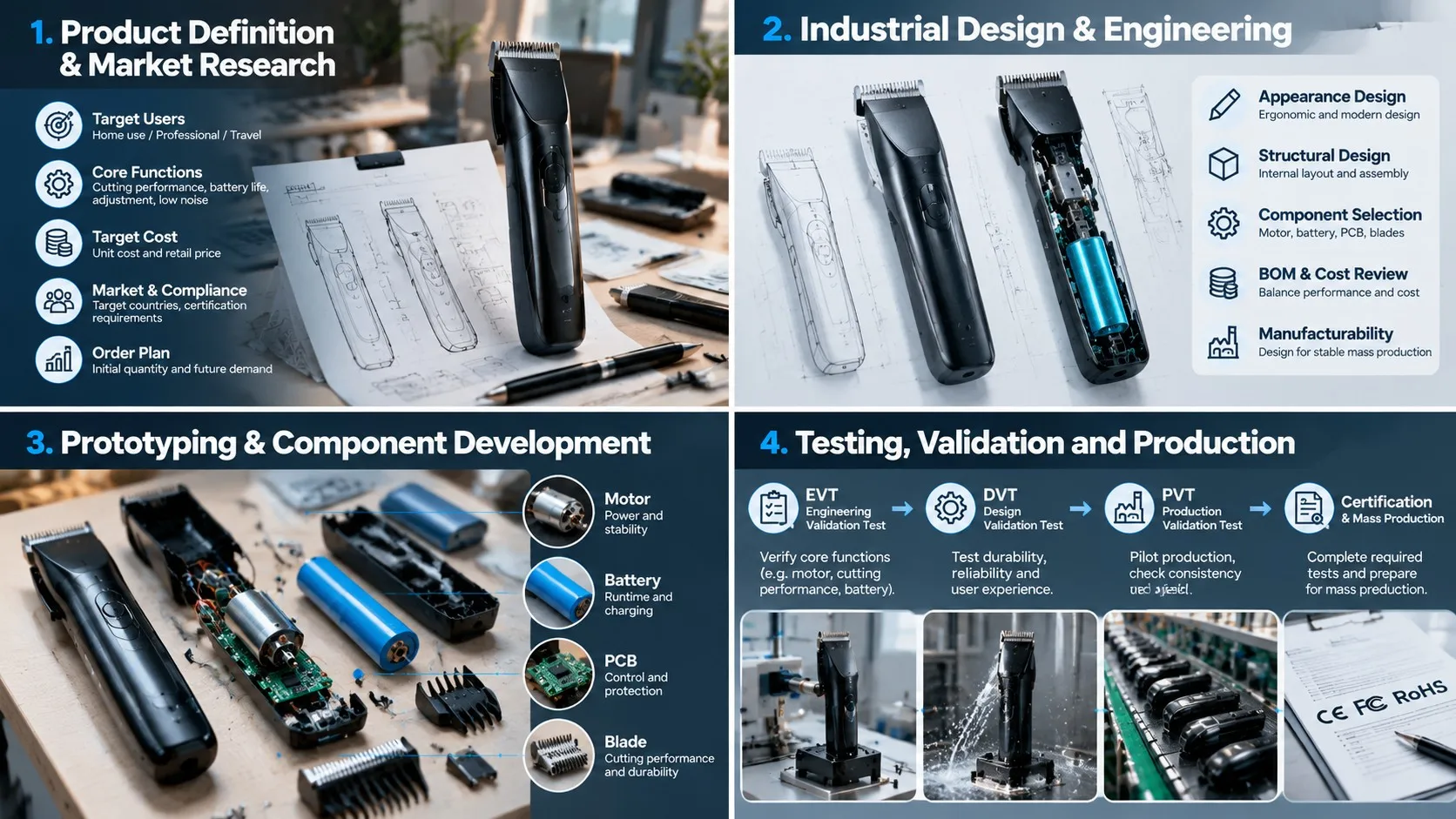
Figure 1: Complete 4-phase engineering and validation workflow for personal grooming hardware.
1 Product Definition: 1–3 Weeks
Before contacting a manufacturer for a quotation, you need to define what you actually want to build.
For a hair clipper, this means deciding:
- Target market: Who will buy the product, and in which countries will it be sold?
- Core functions: What cutting performance, battery runtime, and adjustment options are required?
- Target cost: What is the acceptable unit cost and target retail price?
- Product positioning: Is the product designed for budget retail, professional grooming, or a premium consumer brand?
- Compliance requirements: What safety, electrical, and market-specific requirements apply?
- Order expectations: What is the expected first order quantity and future annual demand?
These decisions form the initial product brief.
Without a clear specification, different suppliers may quote products with different motors, batteries, blades, materials, and accessories. Two quotations may look comparable while representing very different products.
2 Industrial Design and Engineering: 2–6 Weeks
Once the product requirements are clear, the next stage is translating the concept into a manufacturable design.
This stage may include:
- Industrial design and product appearance
- Mechanical structure and internal component layout
- Motor, battery, PCB, and charging solution selection
- Blade structure and adjustment mechanism
- Material selection and assembly design
- Bill of Materials (BOM) development and target cost review
For a hair clipper, the motor and blade assembly influence cutting performance, while the battery and control electronics affect runtime, charging behavior, and product reliability.
Design decisions also affect manufacturing complexity, tooling requirements, assembly efficiency, and the final unit cost. A design that looks good in a rendering may still be difficult or expensive to manufacture.
3 Prototype Development: 2–4 Weeks
The prototype stage turns the design into a physical product.
Depending on the project, this may involve 3D-printed parts, engineering samples, modified existing components, or prototype tooling. The purpose is to check whether the proposed design works in practice.
For a hair clipper, the team may evaluate:
- Cutting performance and blade alignment
- Motor noise and vibration
- Battery runtime and charging
- Housing fit and assembly
- Button operation and handling comfort
- Initial product appearance and finish
A prototype is not necessarily a finished product. It is a way to identify design problems before investing further time and money. If the sample reveals structural problems, poor cutting performance, or inadequate battery life, the design may need to be revised and another sample produced.
4 EVT — Engineering Validation Test: 2–4 Weeks
EVT stands for Engineering Validation Test.
At this stage, the team checks whether the product's core engineering functions meet the agreed requirements. For a hair clipper, tests may cover motor performance, cutting function, operating temperature, battery runtime, charging behavior, and basic electrical performance.
The important point is that testing should be based on measurable requirements rather than subjective judgments such as "the motor feels powerful." For example, a project may define acceptable runtime, charging time, noise limits, or cutting performance before testing begins.
5 DVT — Design Validation Test: 3–6 Weeks
DVT stands for Design Validation Test.
While EVT focuses on whether the engineering solution works, DVT evaluates whether the design is sufficiently mature and reliable for the intended application.
Typical validation activities include:
- Durability and repeated-use testing
- Structural strength and drop testing
- Battery and charging reliability
- User experience and ergonomic checks
- Performance consistency
- Relevant safety and compliance pre-testing
For a hair clipper, the team examines whether the blades remain properly aligned after repeated use, whether the housing withstands expected handling, and whether the product continues to perform consistently over time.
6 PVT — Production Validation Test: 2–4 Weeks
PVT stands for Production Validation Test.
A product may perform well as an individually assembled sample but still encounter problems when manufactured repeatedly on a production line. PVT uses a pilot production run to evaluate whether the manufacturing process can consistently produce products that meet the approved requirements.
The team typically reviews:
- Assembly procedures and production instructions
- Component consistency
- Production yield and defect rates
- Inspection checkpoints
- Packaging and final product configuration
- Traceability and quality records
7 Certification and Mass Production Preparation: Variable
Certification and production preparation do not always happen strictly after PVT. Some activities can run in parallel with engineering and design validation.
Before placing a mass production order, confirm:
- Which certifications and tests are required for the target market
- Whether existing reports apply to the exact model and configuration
- Whether the final product, power supply, battery, and packaging match the approved documents
- Whether any certification testing remains outstanding
- Whether the manufacturer has completed production and quality preparations
How Long Does Each Stage Take?
The following table provides indicative planning ranges for a custom consumer product:
| Development Stage | Estimated Duration | Main Objective |
|---|---|---|
| Product definition | 1–3 weeks | Confirm requirements, market, and target cost |
| Industrial design and engineering | 2–6 weeks | Finalize design, components, and manufacturability |
| Prototype development | 2–4 weeks | Build physical samples and identify design issues |
| EVT | 2–4 weeks | Validate core engineering functions |
| DVT | 3–6 weeks | Validate design reliability and performance |
| PVT | 2–4 weeks | Verify pilot production and process consistency |
| Certification and production preparation | Varies | Complete applicable requirements and prepare for launch |
These stages may overlap, so their durations should not simply be added together to calculate the final launch date.
A reasonable initial planning assumption for many custom consumer products is approximately 3–6 months from a defined concept to mass production readiness. More complex electronics, new tooling, repeated design changes, and extensive compliance testing can extend this period to 6–12 months or longer.
Private Label vs. OEM vs. ODM: Which Is Faster?
If your priority is launching quickly, the development route matters as much as the product itself.
| Development Model | Typical Scope | Timeline Consideration |
|---|---|---|
| Private Label | Existing product with your logo, colors, and packaging | Usually the fastest route because the core design already exists |
| OEM Customization | Modify confirmed product options, functions, or configurations | Depends on the depth of customization and additional testing |
| ODM Development | Develop a new or substantially modified product | Usually requires more engineering, prototyping, validation, and possibly tooling |
Learn more about RYVO's OEM and ODM solutions.
6 Questions to Ask Before Choosing a Product Development Partner in China
1. What exactly is included in the quoted development timeline?
Clarify whether it covers design, samples, tooling, testing, certification, and production, or only the factory's manufacturing lead time.
2. How many sample revisions are expected?
Confirm how revisions are handled, how much they cost, and how they affect the schedule.
3. What are the measurable product acceptance criteria?
Define critical performance, safety, durability, and appearance requirements before approving samples.
4. When does the mass production lead time begin?
Establish whether the clock starts after deposit, sample approval, tooling approval, material confirmation, or another milestone.
5. How are component changes controlled?
Require written approval for changes to critical components and specifications. Unapproved substitutions can affect performance, reliability, compliance, and repeat-order consistency.
6. What evidence will be provided before shipment?
Discuss inspection records, test results, approved samples, and documentation appropriate to the product and market.
How RYVO Helps Brands Move from Product Idea to Production
At RYVO, we support brands, distributors, and online sellers developing personal care products through manufacturing partners in China.
Our role is to coordinate product development and manufacturing activities so that commercial requirements, engineering decisions, and production expectations remain aligned.
Depending on the project, support may include:
- Product definition: Clarifying requirements, target markets, and target costs.
- Product engineering: Reviewing design feasibility, component selection, and customization options.
- Prototype coordination: Organizing samples and helping evaluate the proposed configuration.
- Testing and verification: Reviewing product performance against agreed specifications.
- Production preparation: Coordinating sample approval, quality requirements, and manufacturing readiness.
- Supply chain coordination: Supporting production follow-up, inspection, documentation, and delivery planning.
Explore our product development services to see how we support projects from initial requirements through production preparation.
Ready to Develop Your Next Product?
You do not need a complete engineering specification to start a conversation. Share your product concept, target market, expected quantity, target unit cost, and required launch date with RYVO.
Contact RYVO for Product Development →✓ Direct Engineering Evaluation | ✓ DFM & BOM Review | ✓ Fast Response Within 24h
Frequently Asked Questions (FAQ)
How long does product development take in China?
Many custom consumer product projects require approximately 3–6 months from a defined concept to mass production readiness. Complex electronics or projects involving new tooling, multiple design revisions, or extensive testing may take 6–12 months or longer. Actual timing depends on the product and project scope.
Can private label manufacturing shorten the development timeline?
Yes. Private label typically uses an existing product platform, reducing the need for new engineering and tooling. However, sample approval, branding, packaging, compliance, production scheduling, and shipping still affect the final delivery date.
What are EVT, DVT, and PVT?
EVT validates core engineering functions. DVT validates the design's performance and reliability. PVT checks whether the manufacturing process can consistently produce products that meet the approved requirements.
Does the product development timeline include mass production?
Not necessarily. Always confirm whether the quoted timeline ends at sample approval, production readiness, completion of mass production, or delivery to your warehouse.
Should certification be completed before mass production?
The required compliance plan should be established early. Some testing can run in parallel with development, but the final requirements, applicable documentation, and production configuration must be confirmed for the destination market.
What information should I provide to request an OEM or ODM quotation?
Start with your product concept, target market, expected quantity, target cost, required features, and launch date. Reference photos, competitor products, existing specifications, and testing requirements can help the development team assess feasibility more accurately.