
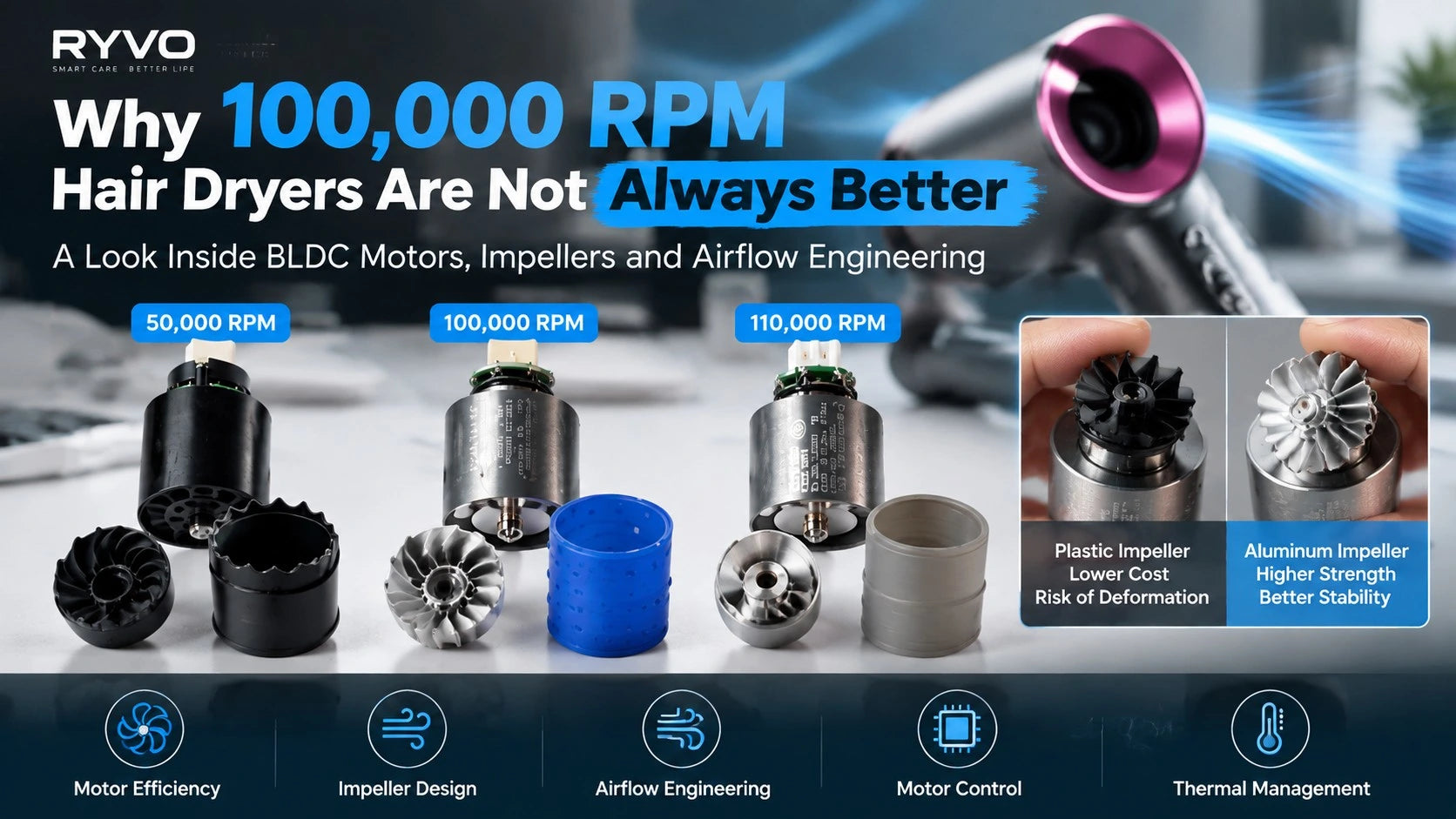
In recent years, the global personal care hardware market has entered a fierce era of high-speed motor competition. Manufacturers and ODM factories heavily promote impressive marketing specifications: 50,000 RPM, 100,000 RPM, 110,000 RPM, and beyond. For most consumer brands and buyers, the assumption seems intuitive: Higher RPM must mean better drying performance.
However, when our hardware engineering team conducts bench teardowns and fluid dynamic testing, the physical reality is far more nuanced. A high-performance hair dryer is not defined by motor rotational speed alone. True drying velocity, acoustic comfort, and long-term lifespan stem from a tightly coupled engineering system: Motor + Impeller Aerodynamics + Airflow Channel Design + Electronic FOC Control + Closed-Loop Thermal Management.
1. The Rise of BLDC High-Speed Motors in Personal Care
Traditional consumer hair dryers have historically relied on brushed AC or DC motors. While cost-effective and structurally simple, brushed motors suffer from mechanical brush friction, heavy carbon dust emission, high acoustic whining, and a limited operational lifespan (typically 200–400 hours).
Modern premium appliances have shifted toward BLDC (Brushless Direct Current) high-speed motors. By replacing physical carbon brushes with electronic commutation and neodymium permanent magnets, BLDC motors unlock fundamental engineering advantages:
- Compact Power Density: Diameter reduced from 70mm down to 29mm–38mm, allowing cylindrical in-handle weight distribution.
- Extreme Velocity: Rotational speeds reaching 100,000 to 110,000 RPM for high kinetic airflow rather than heat-dependent baking.
- Acoustic Optimization: High ultrasonic frequencies (>20 kHz) shift noise outside human auditory sensitivity.
- Extended Longevity: 1,500+ hours of continuous operation without mechanical wear or spark degradation.
💡 The Engineering Dilemma: Does doubling the motor RPM automatically double airflow velocity or cut drying time in half? The answer is emphatically no.
2. Why RPM Is Not the Sole Determinant of Airflow
When brands compare 100,000 RPM vs 50,000 RPM on an OEM quotation sheet, it is easy to assume the 100k unit is twice as powerful. In fluid mechanics, however, the motor is merely the rotational power source. The actual delivered airflow (measured in m³/min or air speed in m/s) is dictated by how efficiently rotational torque is converted into pressurized airflow.
① Impeller Aerodynamics
Impeller diameter, blade pitch angle, 3D curved curvature, and dynamic balance tolerance directly determine pressure lift and vortex dissipation.
② Air Duct Optimization
A poorly shaped nozzle or rough internal chamber creates extreme boundary layer turbulence, wasting up to 40% of the motor's kinetic energy.
③ FOC Control Algorithms
Field-Oriented Control (FOC) vector drive ensures stable torque under variable back-pressure without step-loss, overheating, or high-frequency ripple.
④ Dynamic Thermal Loop
NTC sensors sampling at 100 Hz prevent localized heat pooling around the heating coil, protecting both hair keratin and internal PCBA components.
3. Plastic vs Aviation Aluminum Impeller: The Structural Benchmark
At 100,000+ RPM, the outer tips of a 28mm impeller experience astronomical centrifugal G-forces. This is where manufacturing quality drastically diverges between budget white-label models and professional-grade appliances:
| Impeller Type | Manufacturing & Material | High-Speed Dynamic Balance | Long-Term Failure Risk |
|---|---|---|---|
| Plastic Injection Impeller | Molded ABS/PPS plastic; low tooling & piece-part cost. | Prone to micro-deformation above 80k RPM due to thermal & centrifugal stress. | Bearing imbalance, blade resonance fatigue, screeching noise, premature motor seizure. |
| CNC Aviation Aluminum Impeller | 5-axis CNC machined 6061/7075 aluminum alloy; zero thermal creep. | Precision dynamic balance grade (G0.4 standard) maintained at 110,000+ RPM. | Zero blade deflection, ultra-low vibration (<0.5 mm/s), 100% consistent airflow pressure over 1,500+ hours. |
4. Specifications on Paper vs Real Engineering Execution
Modern consumer electronics sourcing is often plagued by "specification racing". A 100,000 RPM motor paired with an un-aerodynamic housing or an unbalanced plastic fan blade will deliver less practical air speed than a refined 80,000 RPM CNC aluminum system — while generating 3x more vibration and failing within 6 months of retail launch.
What Sourcing Teams & Brand Owners Should Audit in Hair Dryer OEM Factories:
- Motor Rotor Balance Machine: Verify that the factory utilizes dual-plane dynamic balancing equipment for rotors and impellers.
- Wind Tunnel Pressure Bench: Demand calibrated static pressure (kPa) and air volume (m³/min) curves, not just free-spinning no-load RPM.
- PCB Surge & Fuse Protection: Inspect the primary PCBA for thermal cutoffs, varistors (MOV), and dual NTC sensors.
- Acoustic Anechoic Chamber Testing: Review third-party acoustic spectral graphs to ensure noise is concentrated above 15 kHz.
Conclusion & RYVO Engineering Support
Marketing specifications capture buyer attention, but meticulous internal engineering creates brand reputation and 5-star consumer reviews. At RYVO, we help global personal care brands develop verified, high-performance appliances through component-level teardowns, transparent BOM costing, and validated China supply chain manufacturing.
Explore RYVO High-Speed Hair Dryer Platforms
Discover our flagship BLDC platforms engineered with 110k RPM brushless motors, CNC aluminum impellers, and magnetic ionic concentrators: