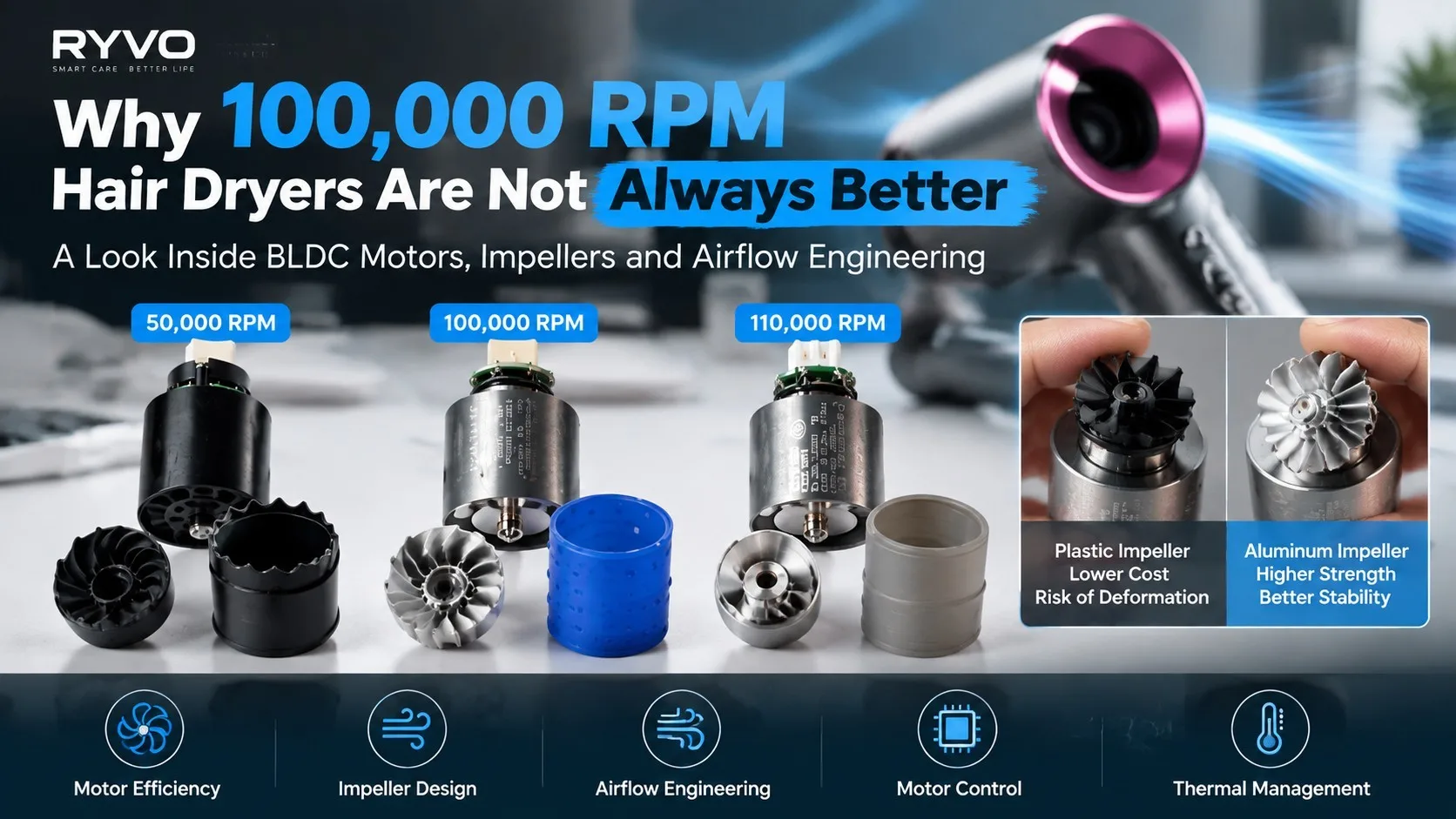
Executive Summary: Beyond the RPM Marketing Race
The personal care appliance market has entered a fierce era of high-speed motor competition, with manufacturers promoting 50,000 RPM, 100,000 RPM, and 110,000+ RPM specifications. While consumer marketing often equates higher rotational speed directly with superior performance, hardware engineering reveals a more complex reality. A high-performance high-speed hair dryer is defined not by peak motor RPM alone, but by a balanced five-pillar system: Motor Efficiency + Impeller Metallurgy + Airflow Channel Dynamics + Electronic Driver Control + Thermal Dissipation. Sourcing teams must look beyond advertised numbers to evaluate structural integrity and aerodynamic efficiency before commissioning OEM mass production.
1. The Rise of BLDC High-Speed Motors in Personal Care
Traditional salon and consumer hair dryers predominantly utilized AC or DC brushed universal motors. While cost-effective and manufacturing-mature, brushed architectures suffer from mechanical brush friction, bulky form factors, elevated acoustic noise, and rapid carbon brush wear.
Modern premium styling tools have rapidly transitioned to three-phase Brushless DC (BLDC) motors. By replacing mechanical commutators with digital electronic driver circuits, BLDC motors deliver distinct manufacturing and user-experience advantages:
- Significant Miniaturization: Compact motor diameters allow integration directly inside the ergonomic handle, improving weight distribution.
- Higher Energy Efficiency: Reduced thermal losses allow higher aerodynamic output per watt of input electrical power.
- Lower Vibration & Acoustic Optimization: Eliminating brush friction reduces mechanical rumble, shifting operational sound into less intrusive frequency bands.
- Extended Operating Lifespan: Without sacrificial carbon brushes, BLDC motors achieve far longer operational durability.
However, an impressive RPM metric on paper does not guarantee superior drying or styling results on its own.
2. The Aerodynamic Equation: Why RPM Is Only the Power Source
When comparing 50,000 RPM, 100,000 RPM, and 110,000 RPM platforms, it is common to assume that doubling rotational speed doubles airflow output. In fluid dynamics, however, the motor serves solely as the kinetic power source. The actual air velocity, static pressure, and drying rate depend on how effectively that kinetic energy is converted into directed, laminar airflow.
Kinetic Motor Power → Impeller Blade Compression → Fluid Channel Ducting → Effective Airflow & Pressure
Four interconnected sub-systems dictate whether high RPM translates into real performance:
- Impeller Aerodynamics: Impeller diameter, blade curvature, angle of attack, and balance precision dictate static air pressure generation.
- Airflow Channel Geometry: Straightening vanes and duct geometry convert turbulent rotational air vortexes into concentrated, linear velocity without internal pressure loss.
- Electronic Driver Algorithms: Sensorless or Hall-sensor field-oriented control (FOC) algorithms maintain constant RPM under varying air inlet resistance.
- Thermal Management: Direct heat dissipation paths prevent PCB MOSFET drivers and motor coils from overheating and throttling power.
3. The Hidden Hardware Difference: Plastic vs. CNC Aluminum Impeller
At rotational speeds exceeding 100,000 RPM, the impeller experiences extreme centrifugal tensile stress. The material selection and fabrication process of the impeller represent one of the most critical structural differences across OEM tiers:
Plastic Injection Impeller
- Advantages: Low unit cost, rapid injection cycle times, lightweight baseline.
- Engineering Risks: Under continuous 100,000+ RPM centrifugal load and ambient motor heat, plastic blades face creep deformation risks, blade tip expansion, and micro-unbalance over time.
Aviation-Grade Aluminum Impeller
- Advantages: Superior tensile yield strength, tight dimensional tolerances, excellent thermal dissipation, and long-term structural rigidity.
- Sourcing Impact: Requires high-precision CNC multi-axis milling and dual-plane dynamic balance calibration, ensuring stable, vibration-free operation across years of use.
4. Engineering Comparison: Component Architecture Scorecard
| Sub-Assembly | Budget / Entry-Tier Design | High-Performance OEM Design | B2B Sourcing Impact |
|---|---|---|---|
| Motor Platform | 50,000 RPM Standard BLDC | 100,000–110,000 RPM Precision BLDC | Enables compact form factors and fast drying velocity |
| Impeller Metallurgy | Molded Engineering Plastic | CNC Machined Aviation Aluminum | Eliminates blade flex; maintains aerodynamic balance |
| Airflow Channel | Standard Open Chamber | Aerodynamic Duct with Flow Straighteners | Maximizes usable static pressure; minimizes turbulence |
| Motor Driver PCB | Basic Square-Wave Driver | FOC Sine-Wave Driver with NTC Sensing | Smooth speed ramping, low electrical noise, overload cut-off |
| Thermal Management | Passive Cavity Airflow | Dedicated Metal Heat Sink & Air Bypassing | Prevents driver overheating during continuous salon usage |
5. Specification Inflation vs. Real Engineering: What Sourcing Teams Must Verify
In cross-border sourcing, comparing factory quotations solely on stated RPM and price leads to high warranty return rates. A 100,000 RPM motor encased in a poorly sealed, high-turbulence body often delivers weaker drying airflow than a well-engineered 50,000 RPM system.
Before confirming an OEM/ODM purchase order, brand product managers should require verified test data on the following:
- Loaded vs. No-Load RPM: Verify motor rotational speed under full air-resistance load, rather than free-spinning bench tests.
- Anemometer Wind Speed & Pressure: Measure exit nozzle wind speed (m/s) and static pressure (mmH2O) at standardized test distances.
- Dynamic Balance Tolerance: Request the motor-impeller sub-assembly dynamic balance rating (target G0.4 or G1.0 balancing grade).
- PCB Thermal Imaging: Inspect driver MOSFET operating temperatures during continuous 30-minute full-power cycles.
6. How RYVO Partners with Brands on Hair Styling Platforms
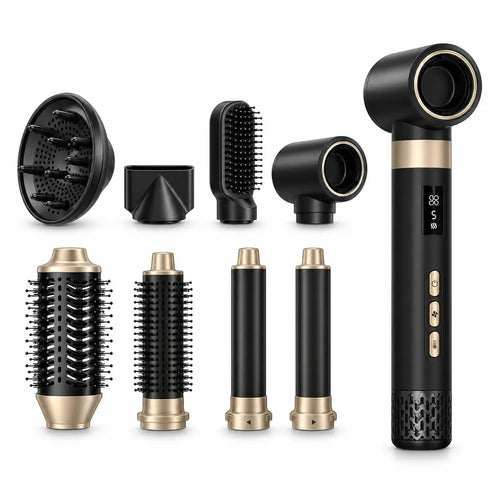
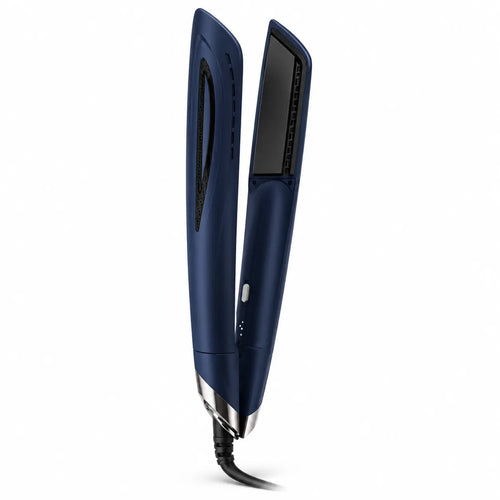
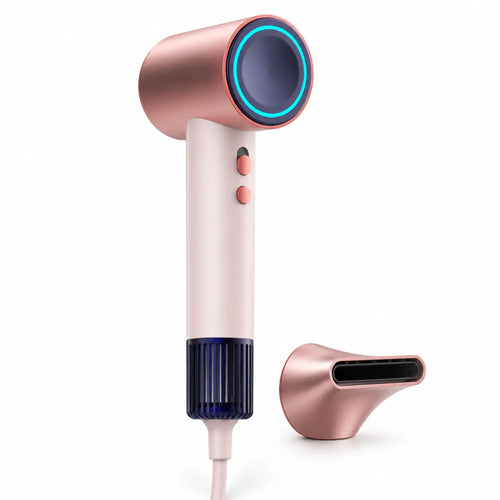
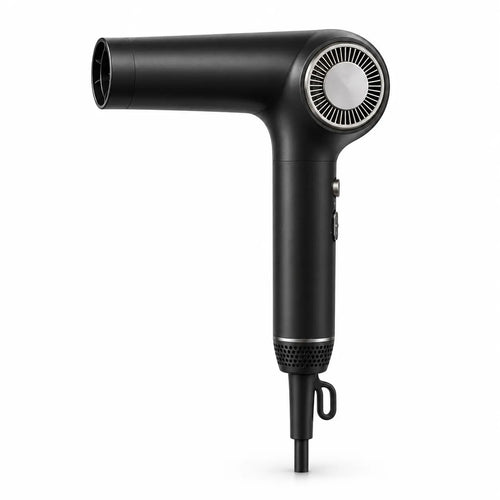
At RYVO, we bridge the gap between creative brand concepts and mass-production reliability. Our hair styling development platforms (including high-speed airflow straighteners and multi-styler systems) are built on verified high-speed motor and airflow engineering:
- Proven High-Speed BLDC Powertrains: Field-tested 100,000+ RPM brushless motor platforms paired with CNC-machined metal impellers.
- Integrated Aerodynamic & Thermal Tooling: Proprietary airflow channels that maximize pressure while maintaining safe operating temperatures for both hair and electronics.
- Turnkey OEM/ODM Customization: Full CMF customization, customized nozzle attachments, laser branding, and certified packaging with accessible low MOQs.
Develop Your Next High-Speed Styling Tool with RYVO
Explore our mature high-speed hair styling platforms or consult with our engineering team for custom OEM/ODM development and component teardown analysis.
View CD-18 High-Speed Platform → Request Spec Sheet & OEM QuoteAbout RYVO: RYVO is a specialized B2B personal care device development and OEM/ODM manufacturing partner in China. We help global brands, Amazon private label sellers, and distributors engineer market-leading oral care, grooming, and hair styling products through rigorous component validation and transparent supply chain engineering.