
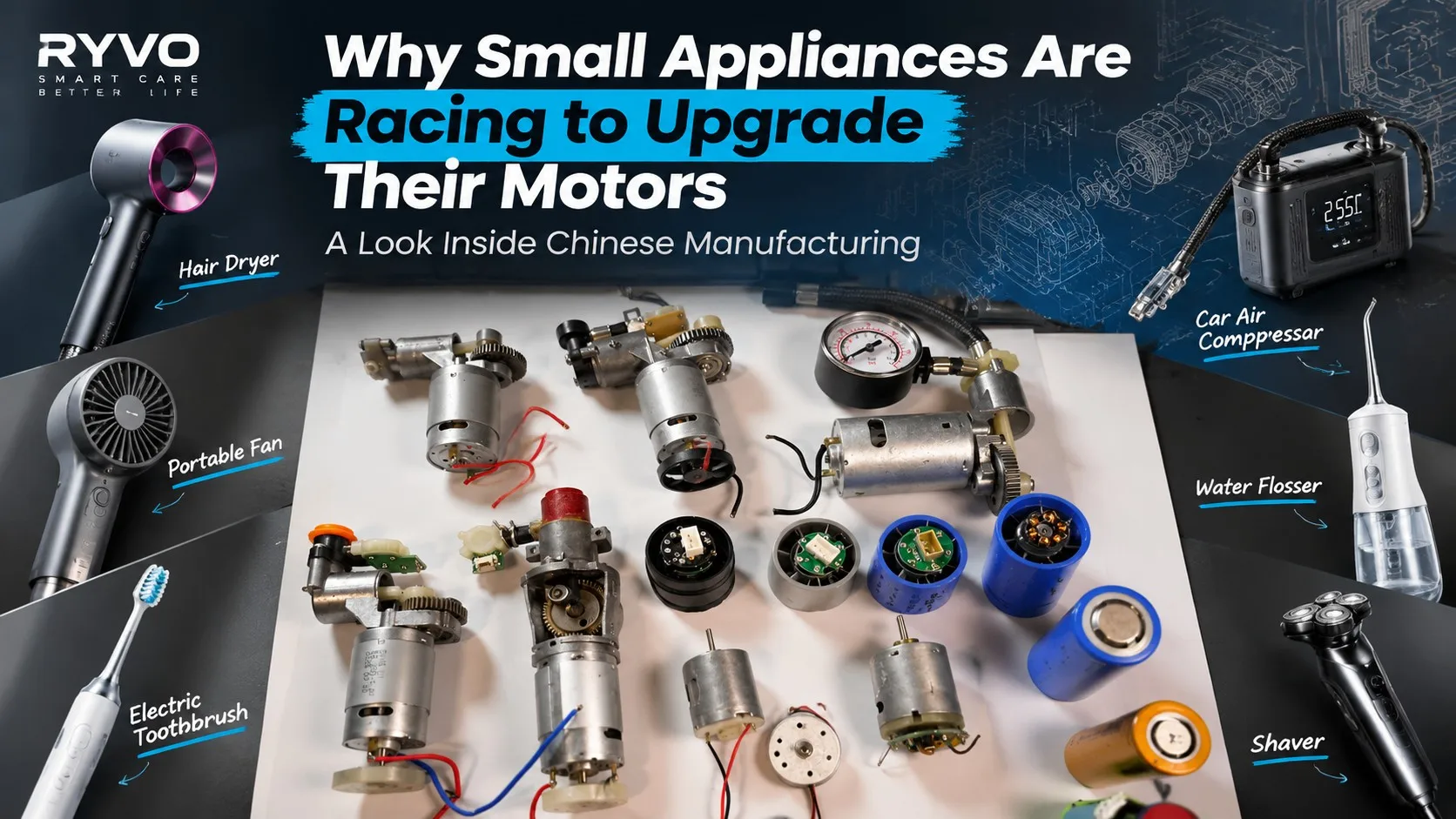
Executive Summary: The Silent Engine Behind Product Differentiation
When consumers evaluate small consumer appliances, their decision is triggered by external aesthetics, industrial design, and marketing bullet points. However, for brand owners, product managers, and sourcing directors, product longevity, user ratings, and true unit economics are dictated by a single internal powertrain: the motor architecture. From high-speed hair dryers crossing 110,000 RPM and brushless portable fans to dual-cylinder air compressors and maglev oral care devices, Chinese manufacturing is in a fierce transition toward high-efficiency motors. Understanding what lies beneath the plastic casing is what separates market leaders from high-return-rate private labels.
1. The Fundamental Principle: Energy Conversion Architecture
Every motorized consumer appliance operates on the exact same fundamental engineering loop:
Electrical Energy (Battery/Mains) → Motor Torque & RPM → Mechanical Drive Mechanism → End-User Experience
While product form factors differ radically across personal care and home electronics, their internal engineering dependencies share identical component challenges:
- High-Speed Hair Dryers: Motor drives a high-pressure aerodynamic impeller to generate high-velocity airflow (>20 m/s) rather than relying on damaging high heat.
- Sonic Electric Toothbrushes: Magnetic levitation motor converts electromagnetic pulses into 31,000–48,000 acoustic micro-vibrations per minute.
- Cordless Water Flossers: Micro DC motor drives a high-precision diaphragm piston pump to deliver 1,400–1,800 pulsating water jets at 40–120 PSI.
- Electric Rotary Shavers: High-torque DC motor powers dual-track precision cutter blades at 8,500+ RPM without stalling under thick stubble.
- High-Velocity Portable Fans: Brushless DC motors spin multi-blade turbines to maximize CFM while minimizing battery draw.
- Car Air Compressors: Heavy-duty motor drives single or dual mechanical piston cylinders to compress air up to 150 PSI efficiently.
2. Category Deep Dives: Why Motors Are Being Upgraded
A. Hair Dryers: The 110,000 RPM BLDC Revolution
Traditional hair dryers relied on bulky AC/DC brushed universal motors spinning at 15,000–25,000 RPM. They generated airflow through brute heating elements, leading to heavy handles (600g+), high acoustic noise (>80 dB), carbon brush dust, and severe thermal damage to hair.
Modern high-speed hair dryers adopt three-phase Brushless DC (BLDC) motors spinning at 100,000–110,000 RPM. This allows:
- Impeller Miniaturization: Motor diameter shrinks from 50mm down to 29mm, fitting directly into the handle for ergonomic balance.
- Acoustic Optimization: High-frequency sound shifts above human hearing thresholds, bringing acoustic levels below 59 dB.
- Lifespan Extension: Eliminating physical carbon brush friction extends operational life from 300 hours to over 1,500+ hours.
B. Portable Fans: Moving Beyond Inefficient Brushed Cores
Low-cost portable fans frequently use cheap brushed DC motors that waste up to 45% of battery power as friction heat, causing short battery runtime and premature motor burnout within 3–6 months. Upgrading to a micro BLDC motor delivers fine-grained multi-speed PWM control, doubling runtime on the exact same 2,000mAh 18650 lithium cell while eliminating motor vibration.
C. Car Air Compressors: Single vs. Dual-Cylinder Structural Dynamics
In high-pressure air pumps, the battle is structural. Single-cylinder compressors struggle with rapid thermal accumulation when inflating large SUV tires. Dual-cylinder reciprocating structures split the mechanical load across two opposing pistons, delivering 2x air volume flow (CFM) at lower motor operating temperatures, preventing thermal safety shut-off during continuous heavy-duty inflation.
3. Motor Technology Comparison Scorecard
| Motor Technology | Typical Applications | Efficiency & Lifespan | Acoustic Noise | OEM Sourcing Impact |
|---|---|---|---|---|
| Traditional Brushed DC | Budget shavers, entry fans, low-tier pumps | Low (50-65% eff., ~300 hrs) | High (68-80 dB) | Ultra-low unit cost; high warranty return risk |
| High-Speed BLDC (Brushless) | High-speed hair dryers, premium turbine fans | High (85-92% eff., 1,500+ hrs) | Ultra-Quiet (<58 dB) | Higher retail perceived value ($69-$199 retail tier) |
| Magnetic Levitation Sonic | Sonic toothbrushes, facial cleansing brushes | Superior (No mechanical wear, 3+ yrs) | Whisper Quiet (<50 dB) | Standard for FDA/CE compliant oral care brands |
| High-Torque Dual Cylinder | Automotive tire inflators, high-PSI pumps | Heavy Duty (Continuous pressure output) | Controlled Low Vibration | Essential for professional outdoor & roadside SKUs |
4. The Sourcing Trap: "Specification Inflation" vs Real Engineering
In competitive manufacturing hubs, some factories engage in specification inflation—advertising impressive numbers on the quote sheet that do not hold up under real laboratory stress testing:
- Inflated No-Load RPM: Quoting 110,000 RPM at zero resistance, but dropping below 70,000 RPM once the aerodynamic fan cage is attached.
- Inadequate Driver IC Thermal Dissipation: Using cheap unbranded MOSFET driver chips on the PCB that overheat after 8 minutes of continuous operation.
- Substandard Rotor Dynamic Balancing: Failing to perform dual-plane dynamic balance calibration on high-speed rotors, causing hand fatigue, micro-chatter, and bearing failure.
- Undersized Lithium Discharge Rates: Pairing high-draw motors with standard 1C discharge battery cells, resulting in voltage sag, reduced motor torque, and severe battery degradation.
5. How RYVO Helps Global Brands Engineer Better Products
At RYVO, we believe that successful OEM/ODM manufacturing starts with complete transparency into the product's internal architecture. Rather than simply acting as a middleman, our engineering and quality verification team in China conducts full BOM component audits before production begins:
- Component-Level Teardown & Benchmarking: We analyze motor coil gauge, magnet grades (N38/N52 Neodymium), and bearing tolerances against top global brands.
- Thermal & Airflow Simulation: We verify PCB driver temperature dissipation and airflow path resistance to ensure sustained performance under peak loads.
- Strict Reliability & Aging Protocols: Every production batch undergoes 100% full-load aging tests, acoustic decibel chamber verification, and drop durability checks.
- Modular Customization with Low MOQ: We help brands leverage proven, verified motor platforms to customize exterior CMF (Color, Material, Finish) without incurring high tooling costs.
Build Your Next Product with Verified Engineering
Whether you are developing a high-speed hair styler, a sonic electric toothbrush line, or a custom grooming device, RYVO provides the supply chain transparency and engineering support you need to scale.
Explore Product Platforms → Request Teardown & OEM QuoteAbout RYVO: RYVO is a personal care product development and OEM/ODM manufacturing partner connecting global brands, Amazon sellers, and distributors with reliable Chinese manufacturing capabilities. We bridge the gap between product ideas and mass production through verified component selection, rigorous quality control, and deep product architecture understanding.